_(1).png)
Published July 13, 2026
New Construction vs. Resale in Waxahachie ISD: Which Is Right for You in 2026?

.jpg)
If you're house hunting in Waxahachie ISD this year, you're walking into a market that looks very different than it did even eighteen months ago. For most of the last decade, "new construction" meant paying a premium for brand-new everything. That's no longer automatically true — and it changes the math for a lot of buyers.
Here's what's actually going on, and how to think through the decision for your own family.
The Big Shift: New Homes Are No Longer the Pricier Choice
Nationally, new-construction homes have historically sold for more than resale homes — sometimes a lot more. In Texas, that new-home premium ran as high as 53% back in 2015. By early 2025, it had shrunk to roughly 6%. As of the first quarter of 2026, it's essentially gone: the median new-construction home nationally priced at $403,200, just slightly below the median resale home at $404,600, according to National Association of Home Builders data pulled from the U.S. Census Bureau and the National Association of Realtors.
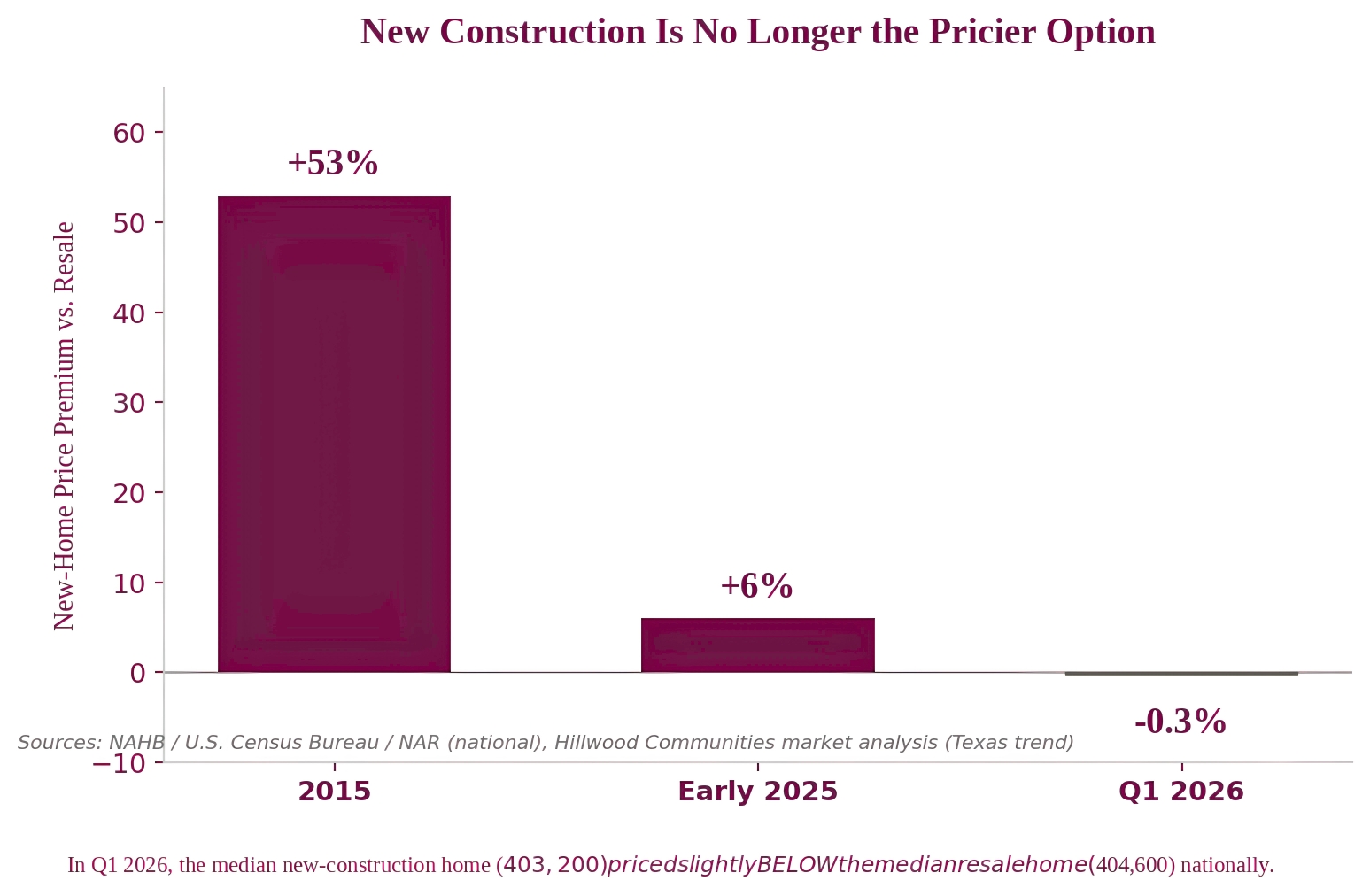
Why the flip? Builders have spent the past two years fighting for buyers in a higher-rate environment. Roughly two-thirds of builders nationally are now offering incentives — rate buydowns, closing cost credits, design upgrades — and more than a third have cut list prices outright. Meanwhile, resale inventory has stayed tight because so many current owners are sitting on mortgage rates well below today's, and they're in no hurry to give them up. Fewer resale listings plus steady demand has kept resale prices climbing, even as new-home prices have eased.
That national trend is showing up locally, too. Builders across Ellis County — John Houston Homes remains especially active in the Waxahachie ISD footprint — are leaning on incentives to move inventory, which is opening up real opportunities for buyers who might have felt priced out of new construction a year or two ago.
Where the Waxahachie Market Stands Right Now
A few snapshot numbers, current as of mid-2026:
Home values: Depending on the data source and methodology, Waxahachie's typical home value runs from the high-$300,000s (Zillow's home value index, list-based sources) up toward the $450,000–$500,000 range for active listings, which tend to skew toward larger, newer homes.
Days on market: Homes are taking noticeably longer to sell than they were a year or two ago — well into the 60–120+ day range in many segments. That's a meaningful shift toward buyer leverage compared to the multiple-offer environment of 2021–2022.
Mortgage rates: As of mid-July 2026, 30-year fixed rates are hovering in the mid-6% range (roughly 6.4%–6.7% depending on the lender and the day), which is close to where rates sat a year ago.
Household income needed: Comfortably affording a median-priced Waxahachie home today generally requires household income in the neighborhood of $100,000+, depending on down payment and debt load.
The takeaway: this is a market where buyers have room to negotiate — on both sides of the new-construction-versus-resale decision.
New Construction: What You're Really Getting
The advantages:
Builder warranties. Most new homes come with a "1-2-10" warranty — one year covering workmanship and materials, two years covering major mechanical systems (plumbing, electrical, HVAC), and ten years covering major structural components.
Energy efficiency. New homes are built to current energy codes, with better insulation, newer HVAC systems, and often lower utility bills than a comparable resale home.
Customization. Depending on how far along construction is, you may be able to select finishes, layout options, and upgrades.
Active incentives. With builders motivated to sell, this is a strong window for negotiating rate buydowns, closing cost assistance, or design-center credits — even if the base price itself doesn't move much.
Nothing to fix. No aging roof, no 20-year-old water heater, no surprises from a previous owner's DIY project.
The trade-offs:
Timeline. A home that isn't started yet can take 7–12+ months to complete. If you need to move quickly, a spec home that's already finished or nearly finished is a better fit than a to-be-built lot.
MUD and PID fees. Many newer master-planned communities in North Texas — including some in the Waxahachie ISD footprint — are financed through Municipal Utility Districts (MUDs) or Public Improvement Districts (PIDs). These add a separate tax rate or annual assessment on top of your regular property taxes to pay off the infrastructure bonds that built the neighborhood's roads, water, and sewer systems. This is the single most common surprise for new-construction buyers, and it can add hundreds of dollars to your monthly payment. Always ask specifically whether a community has a MUD or PID before you fall in love with a floor plan.
Less mature landscaping. New neighborhoods take a few years to grow into themselves — expect young trees and a newer streetscape rather than established shade.
Limited price negotiation. Builders will often move on incentives before they'll move on the base sales price, since public pricing affects the appraisal comps for the whole community.
Resale: What You're Really Getting
The advantages:
Established neighborhoods. Mature trees, settled landscaping, and a track record you can actually research — school ratings, HOA history, neighbor turnover.
Often lower effective tax rate. Resale homes in older parts of Waxahachie ISD typically don't carry MUD or PID assessments, so the property tax portion of your payment can be meaningfully lower than in a new master-planned community, even at a similar purchase price.
Move-in timeline. Closing typically happens in 30–45 days rather than several months to a year.
More price flexibility. Individual sellers — especially those who've been on the market a while in today's slower-moving environment — are often more willing to negotiate on price, repairs, or closing costs than a production builder.
Character. Older homes, especially in and around Waxahachie's historic districts, offer architectural detail you generally won't find in new production floor plans.
The trade-offs:
Aging systems. Roof, HVAC, water heater, and foundation all have a shelf life. A good inspection is non-negotiable.
No builder warranty. Unless the seller offers a home warranty, you're taking on maintenance risk from day one.
Dated finishes. Kitchens and bathrooms may need updating to match current buyer expectations, which adds cost on top of the purchase price.
Energy costs. Older insulation, single-pane windows, and older HVAC equipment can mean higher monthly utility bills.
Comparing the Real Monthly Cost
Sticker price only tells part of the story — property taxes are often the biggest hidden variable between a new-construction and resale purchase in this market. Here's what that can look like on a $400,000 home, comparing a resale home in an established Waxahachie ISD neighborhood against new construction in a master-planned community with a MUD/PID in place:
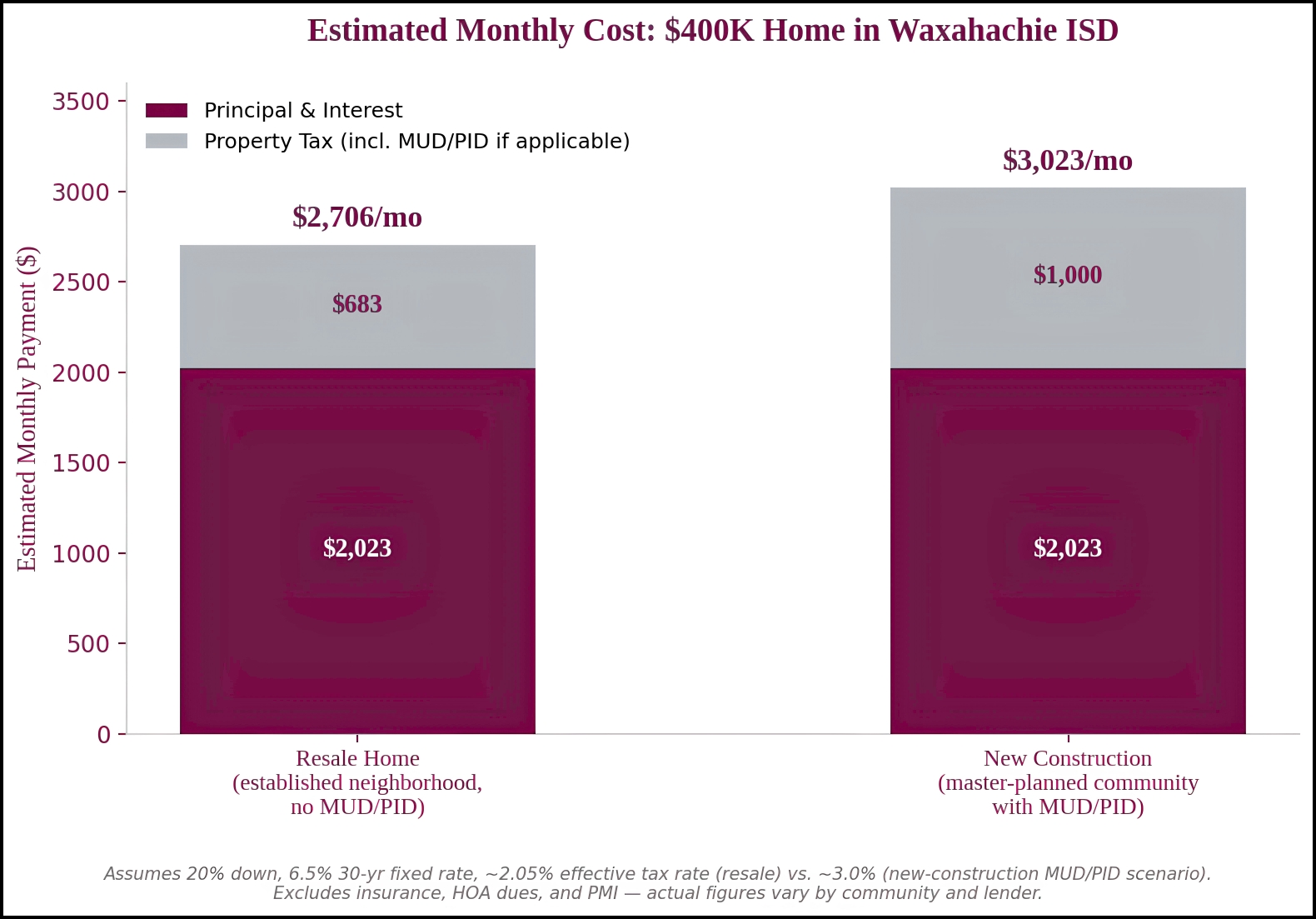
That roughly $300+/month gap is exactly why a lower-priced new-construction home doesn't always end up cheaper to own than a slightly higher-priced resale home. It's also why every new-construction offer should include a clear-eyed look at the full tax picture — not just the base list price.
A few other numbers worth knowing for anyone buying in Waxahachie ISD this year:
Waxahachie ISD's 2025 tax rate was $1.1681 per $100 of assessed value, split between maintenance & operations and debt service — unchanged from the prior year and down significantly from where it stood in 2018.
The state homestead exemption currently sits at $100,000 off your home's value for school tax purposes, with a voter-approved increase to $140,000 in the pipeline.
Combined effective tax rates (ISD + city + county) for a typical Waxahachie home run roughly 2%–2.2%, before factoring in any MUD or PID on top.
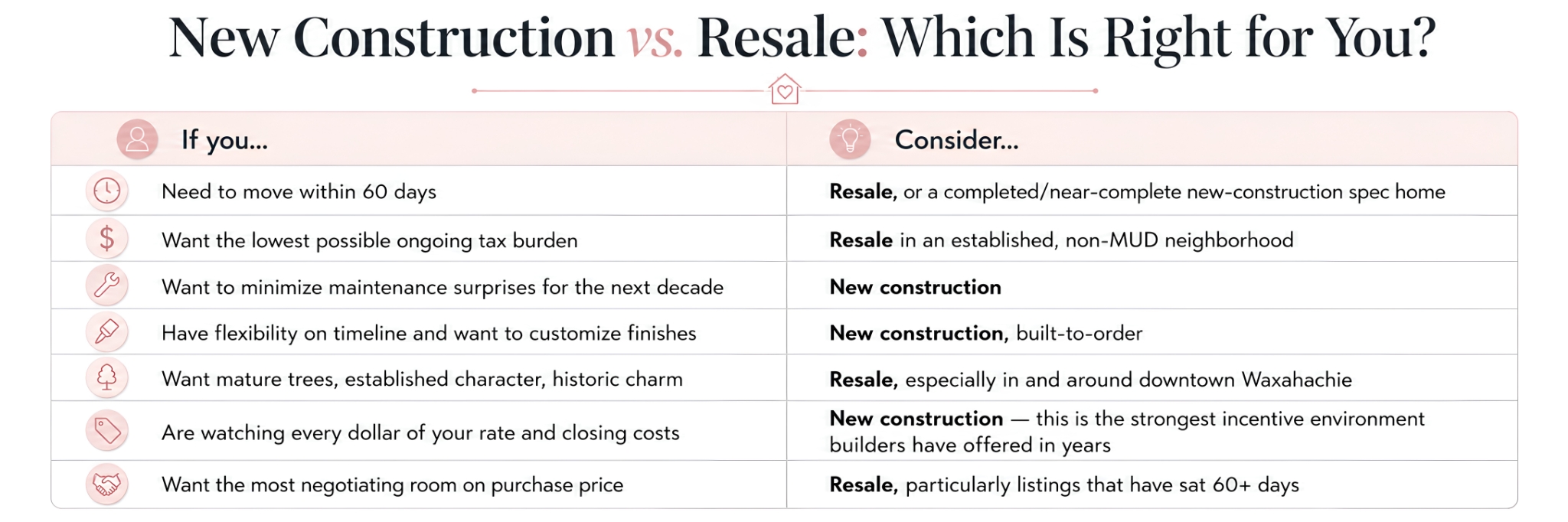
There's no universally "right" answer — it depends on your timeline, your tolerance for maintenance, and how you weigh a lower purchase price against a potentially higher long-term tax bill. What I can tell you after 21+ years doing this in Ellis County: the buyers who feel best about their decision are the ones who ran the full numbers — taxes, HOA, insurance, and all — before they picked a lane, not after.
If you'd like help comparing specific new-construction communities against resale options in your target neighborhoods and budget, I'm happy to pull current listings and run the real numbers side by side for you.
Amy | Keller Williams Ellis County — Serving Waxahachie, Maypearl, and Midlothian ISD
Sources: National Association of Home Builders (NAHB), U.S. Census Bureau, National Association of Realtors, Freddie Mac Primary Mortgage Market Survey, Ellis County Appraisal District, Waxahachie ISD, Hillwood Communities market analysis. Figures current as of July 2026 and subject to change — always confirm current rates, prices, and tax details with your lender and agent before making a decision.